Workers at the Amos Hall Starbucks unionized Friday in a 10-3 vote, creatingone of the largestStarbucks unions in the country with 44 eligible employees.
TheNational Labor Relations Boardannounced the results around 2 p.m., tallying ballots initially mailed onApril 22.Following the NLRB’s certification of the results, the union canelect a bargaining committeeand begin contract negotiations with company representatives.
The location’s eligible baristas and shift supervisors chose to joinWorkers United, a Service Employees International Union affiliate representing more than 80,000 workers in North America. The results bolster a wave of successful organizing efforts at more than50 locationsacross the country, includingonein Pittsburgh’s Bloomfield neighborhood.
Employees at the store officially petitioned to unionize onMarch 4, citing staff shortages, limited hours and unresolved concerns with upper management. The complaints were a familiar refrain for Starbucks employees and others working in food service — an industry marked by high turnover and relatively easy-to-replace employees that makesorganizing a union particularly difficult.
Though company leaders have long maintained a union-free model, more than 200 Starbucks locations — out of 9,000 nationwide — have petitioned to unionize since last August, includingeleven this week. Onlyfive electionshave ended in confirmed defeat for union organizers as of Tuesday.
Employees atsix otherPittsburgh locations, including one less than a mile from Amos Hall onSouth Craig Street, have also petitioned to hold union elections, though exact dates are pending.
Starbucks did not immediately respond to requests for comment on the Amos Hall results.
Starbucks Workers Unitedhas accused the company of “outrageous anti-union” activities, filing119Unfair Labor Practice complaints since Nov. 4. The coffee chainfiled twoof these charges against Starbucks Workers United in April, citing attempts to intimidate employees and customers who withheld support for unionization. The NLRB has also sued Starbucks for deterring unionization through an“overly-broad and discriminatory”employee handbook.
Company leadersannounced pay raisesfor stores across the country on Tuesday, but said they won’t apply to locations that have unionized or petitioned for a union. Several months ago, organizers said the company threatened to shut down stores in Buffalo, N.Y., the birthplace of Starbucks unionization.
In an email to thePost-Gazette, a Starbucks corporate spokeswoman rejected claims of store closures as “false,” adding that the company respects its employees’ right to organize.
Former Pitt quarterback Kenny Pickett is staying in Pittsburgh.
The Pittsburgh Steelers selected former Pitt quarterback Kenny Pickett with the No. 20 overall pick in the 2022 NFL Draft. Pickett became the first Pitt quarterback to be selected in the first round since the Dolphins selected Dan Marino in 1983.
Pickett broke Marino’s records in 2021,throwingfor 4,319 yards and 42 touchdowns en route to Pitt’s first ACC Championship. Pickett was also a Heisman Finalist in 2021, Pitt’s first since wide receiver Larry Fitzgerald in 2003.
Draft experts expected teams to pick the former Panther anywhere from the No. 6 pick to somewhere in the second round. Experts have called this draft one of the mostunpredictablein recent history. ESPN analyst and former Panther Louis Riddick said early last week that he wasn’t sure who was going to pick Pickett.
“From No. 6 [overall pick] down, anything is possible,” Riddick said. “I would not want to be Kenny Pickett on Draft night. I just don’t know.”
The NFL held the Draft in Las Vegas this year and while Pickett received an invitation, he opted to stay in New Jersey to be with his family and friends, he said on the Breneman Shows Uppodcast. Riddick said Pickett’s character and his family-oriented principles will serve him well in his NFL career.
“He’s aces, man — A pluses across the board,” Riddick said. “I think when you’re drafting quarterbacks and drafting people in the first round, the number one thing that you want as a team builder is you want someone who will allow you to lay your head down at night and sleep peacefully because you can trust that they are going to be a pro … That’s what Kenny Pickett is — he’s a pro.”
Pitt fans will get a chance to see Pickett in the NFL when the season starts in September. Pickett will vie for playing time this summer at training camp and the pre-season with the Steelers.
Pitt officials said Thursday that 93 students and 25 employees tested positive for COVID-19 from April 13 to 19.
Theemailsent by Pitt’sCOVID-19 Medical Response Officesaid although the seven-day average of positive tests on the Pittsburgh campus has increased again this week, “cases remain mild and relatively low in number, with county hospitalizations staying low.”
The CMRO also said masking in public can protect against transmission of COVID-19, and to stay home if you don’t feel well.
People who are 50 years or older or immunocompromised are eligible for a second booster dose, which is available at thePitt CoVax Vaccination Centerin Nordenberg Hall. The email also encouraged people toupdatetheir current booster information.
It’s been a long year — though for these editors, time has flown by. Though we’re sad to say goodbye to six editorial board members, we’re grateful for all the memories we made during our time together and the positive impact they had on the paper and their peers.
Martha is the backbone of the news desk. She’s been at The Pitt News for three years as a writer and editor, and has consistently shown just how dedicated, hardworking and kind she is — especially when she stepped up to become head news editor over winter break.
While this position came with a lot of responsibility and commitment, being the amazing person she is, Martha rose to the challenge. Not only was she tasked with a bigger leadership role, she also had to train two new assistant news editors — us. With her kind and thoughtful personality, Martha did just that and more, creating a welcoming and inclusive environment for everyone on the news desk.
Martha has also been vital to the future success of the news desk. Her meticulous training helped both editors and writers succeed in their jobs. She’s even won this year’s “Best Boss” superlative, which she definitely deserved.
Martha’s bubbly personality and impeccable fashion taste will be greatly missed next year. But we know she’ll be successful in her career as an operations analyst at BNY Mellon in Pittsburgh.
Martha Layne, News Editor. (Pamela Smith | Visual Editor)
Jon Moss, Editor-in-chief // Rebecca Johnson, Managing Editor
One of my favorite Jon memories is when Joe Biden won the presidency in November 2020. Jon, who faithfully spent days glued to CNN and Steve Kornacki, slept through the morning announcement that we had a new president — and didn’t wake up until approximately 3 p.m. I promptly sent him thesurprised pikachumeme when he finally responded to my texts about all the work we had to finish, which, needless to say, he didn’t appreciate.
The crazy thing about this story, and why it’s so funny for me to relive, is because it’s so out of character for Jon. Jon has worked at TPN for four years, two of which he spent as editor-in-chief. This makes him, in his own words, a “TPN lifer.” He’s written award-winning work in his time, includingexclusive interviewswith Pitt’s chancellor, anexpose on deficient bridgesin Oakland andcompelling data journalismon declining Black student enrollment at Pitt. He’s also designed new, cutting-edge web designs, graphics and layouts for the paper, and has even pulled an all-nighter covering atumultuous Student Government Board election.
But anyone who’s seen his byline knows that Jon is a talented reporter. What you may not know is that Jon is a great teacher. When I joined TPN during my first year, I didn’t know anything about journalism. Everything I know now is thanks to him. He’s dedicated so much time to helping me and countless other reporters and editors at TPN flourish, which is a sacrifice I can’t possibly thank him enough for.
While I’ll definitely miss Jon’s editing skills and our nightly ritual of me attempting to explain pop culture references to him, I’m so excited to read his byline in the Pittsburgh Post-Gazette this summer and wherever he lands next. Congrats on your well-deserved TPN retirement!
Editor-in-Chief Jon Moss at his desk in The Pitt News office. (Clare Sheedy | Assistant Visual Editor)
When I first began my time in the multimedia department at The Pitt News, I was extremely nervous. I worried about whether I would do a good job and if I knew enough to be a helpful part of the team. When Nate held the first multimedia meeting I attended in January 2021, that anxiety began to melt away.
Nate provided a safe space for me to experiment with video production, and helped me bloom into a confident videographer. Whenever I had a question, he was there to answer it, and whenever I made a mistake, he was there to gently guide me to help correct it. Without him, I don’t think I would have developed such a passion for videography, and I’m certain that I wouldn’t have achieved as much as a staff member, including shooting a video that spread nationally.
The thing about Nate is that he never takes responsibility for the department’s success. He always celebrates his staffers’ success, selflessly omitting his role in every video released. Nate always made me feel supported, and I knew I could rely on him at TPN. I hope to take the same care and support Nate showed us, and provide it for next year’s multimedia staff when I’m editor. I hope I’m half as good of a boss as Nate.
It’s extremely sad to see him graduating this year, but I am certain he is going to do great things in his life. Congrats Nate, and thank you!
Riley Kleemeier, Copy Chief // Jane Patz, Assistant Copy Chief
Riley is the best copy chief an assistant copy chief could ask for. I can always count on her to answer a 10 p.m. text on her night off because I can’t remember whether we’re able to print the word “f—” in a news column if it’s part of a quote. In fact, I texted her just now to fact check this rule so her senior send-off would be up to Pitt News standards. “Yes just bleep it out. F—,” Riley Kleemeier said in response.
I have many fond memories to look back upon with Riley, like our Copy Chief Cocktail nights and that time she almost gave me COVID right before Thanksgiving break. She’s smart, funny and a really great copy chief. I have no doubt I will one day see her name on the New York Times bestsellers list, and I can say, “Wow, I know her! She almost gave me COVID in college!” and then buy 15 copies.
Riley is graduating with a famously employable English literature and writing degree. She will make all of us at The Pitt News proud when she continues her copy editor duties as the digital content manager for a publishing company in June, but we’ll miss her around the office.
Shruti will be sorely missed at The Pitt News. For the last year and a half, she’s contributed amazing layout for our print edition every week and tirelessly worked on our Silhouettes magazine. For all of her four years at Pitt, she’s been a skilled and reliable illustrator, taking on a lot of last-minute illustrations and covers, and pretty much single-handedly supporting the visuals desk through some tough deadlines.
Every Tuesday evening Shruti and I would discuss the print cover and check over visuals. Shruti always contributes thoughtful and creative ideas to our discussions, putting up with a lot of my overly ambitious layout ideas and executing them better than anyone else. When we were finishing the “ACC Champ-yinz” cover, Shruti patiently went through about 30 different shades of blue and gold for the font, moving the text back and forth three pixels at a time. Of course, when Shruti discovered a different, more eye-catching text layout, we finally finished our cover.
Shruti will graduate with a psychology degree and attend Duquesne University for graduate school, where I’m sure she will continue to do and create great things. Congratulations, Shruti!
Shruti Talekar, Layout Editor. (Pamela Smith | Visual Editor)
Stephen Thompson, Sports Editor // Dalton Coppola, Assistant News Editor
Stephen Thompson leaves behind a legacy. He spent four years serving the sports desk as an editor and writer, and he’s followed the men’s basketball team through all of its highs and lows. Anyone who reads Stephen’s work is quick to notice his gift for writing. He spins boring and mundane game recaps into riveting scripts. His player profile stories go much further than the court and tell the true story of the person behind the player. His columns are well thought out and profound, while staying away from the cliches that even the most prolific writers fall victim to. But what most of you don’t know is that Stephen is an even better person than he is a writer.
Stephen took a first-year writer like myself under his wing when he didn’t have to. He was graduating in a year and all he needed to do was write his own stories. But he didn’t do that. He showed not just me, but all of our writers, how to be a professional, how to write and how to be a better person.
While I won’t miss his Boston sports fandom, I will miss sharing an office with Stephen. The sports desk will never be the same without him. I speak for all of his co-workers, writers and friends when I say that we will miss him dearly at Pitt. I can’t thank Stephen enough for everything he’s done for me personally and for our newspaper. I’m so excited to watch Stephen flourish as a sports writer and professional going forward. But if there’s one thing I hope Stephen takes with him, it’s that the Red Sox will always be the Yankees’ little brother. Cheers to you, Stephen.
Stephen Thompson, Sports Editor. (Clare Sheedy | Assistant Visual Editor)
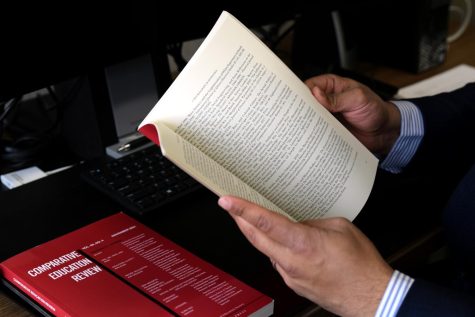
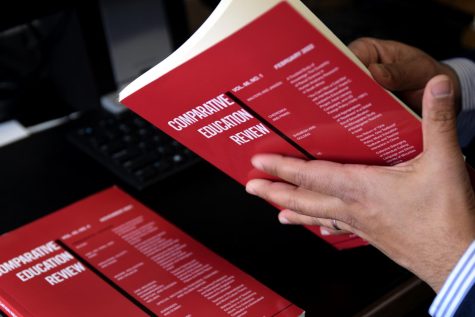
Najeeb Shafiq studied comparative education as a child, whether he knew it or not.
His family lived in the ascendantly wealthy United Arab Emirates, where his father worked as a government accountant. They returned to Shafiq’s poorer native country of Bangladesh each year, making him perceptive to inequality at a young age.
“Many kids were not in school. Most kids did not go beyond primary school, so you saw child laborers everywhere,” Shafiq said. “So the contrast for me was something that I was always very sensitive to.”
As a professor of education, economics and international affairs at Pitt, there’s great breadth to Shafiq’sresearch, but he focuses oneducational opportunities and non-monetary impacts of schooling in lower-income, predominantly Muslim countries. With a first-hand understanding of the complicated trade-offs many families face when deciding to send their kids to school, his experience in Bangladesh helped inform some of his early work on child labor.
“You need your girls and boys to somehow get some education, some of their basic literacy and numeracy, but you need them to support the house,” Shafiq said. “Telling that story in a quantitative way, a sophisticated way that reflected reality was important to me.”
He also serves asexecutive directorof the Pitt-based Comparative and International Education Society — an association of researchers, policymakers and educators who focus on education outside the United States. With the help of a “small but incredibly professional staff,” he oversees the organization’s finances, arranges conferences and advises the board.
A pair of Bangladeshi economists, Muhammad Yunus and Amartya Sen, inspired Shafiq to pursue a Ph.D. in economics and education from Columbia University in 2005, despite a career in academia being “unusual” for the time.
“They taught economics and they were also able to contribute in a positive way to the world, and I just thought that was powerful,” Shafiq said. “They were my inspirations, but none of this would have been possible without, of course, my parents. My mother and father were extraordinarily supportive.”
Shafiq’s gratitude toward America is yet another glimpse of his comparative inclinations.
“All of this, all of these dreams would not have happened if it had not been for the opportunities this country and its institutions have given me,” Shafiq said. “Universities in other countries are not as willing to provide tenure-track opportunities to foreigners from lower income countries.”
Henry Levin, professor emeritus of economics and education at Columbia University, advised Shafiq while he pursued his Ph.D. Levin said while many attend graduate school primarily to climb the socioeconomic ladder, Shafiq dedicated himself to a “kinder and more productive” society.
According to Levin, Shafiq hasn’t lost that pure intention, despite his professional workload.
“I’m sorry to have to differentiate and say that a lot of job responsibilities and organizational responsibilities are not compatible with kindness, justice, even true productivity,” Levin said. “He combines these responsibilities with caring about other people and what they care about.”
Clare Sheedy | Assistant Visual Editor
Shafiq began teaching at Pitt in 2010, a campus he called his “favorite” in letters to friends and family when he toured as a prospective graduate student.
“There is really nowhere else I’d rather be a professor than Pitt,” Shafiq said. “The spirit of collaboration at the University of Pittsburgh is just off the charts.”
Shafiq said interdisciplinary communication is “the most normal thing” here, something he found lacking at other institutions. Prior to joining Pitt, Shafiq said he received excited emails about his prospective arrival from future colleagues in the School of Education, but also from other parts of the University. Now a decade into his tenure, he’s presented at political science seminars and psychology labs, and regularly gets detailed feedback on his research from friends in a variety of departments.
Maureen McClure, an associate professor in the department of educational foundations, organization and policy and director of the Institute for International Studies in Education, helped recruit Shafiq to Pitt. A member of CIES, she said when working with Shafiq, “what you see is what you get.”
Shafiq excels at analyzing problems in a measured, thorough way, all while maintaining a sense of humor in good times and bad, according to McClure. He’s a “diplomat” in his role as executive director at CIES, and a “good global citizen” across the board.
“He is a methodologist, he is a comparativist, he is a very fine statistician and he puts that to work for the social good,” McClure said.
Shafiq preaches a slow and steady strategy to his students, one that will lead them to a satisfying, sustainable career. Many doctoral students will rush to build an impressive resumé by contributing to a well-established professor’s research, Shafiq said, but this prevents students from nurturing their academic independence.
Shafiq admitted that forgoing early publications and citations in top journals may be “frustrating” for students, but it will leave them “much better equipped for the long run” — a lesson imparted by Levin at Columbia.
Nuance and integrity reign supreme for Shafiq, guiding his research despite conformist pressures.
Following the 9/11 attacks, policymakers coalesced around education as a tool to root out extremism and seed support for democratic advancement in Muslim countries, Shafiq said. His research found that while educated people tend to support a degree of democratic advancement, support for suicide bombings increased in some cases.
Governments, international organizations and journalists seek clear-cut, simple answers. Nuanced research isn’t as “readily accepted” in policy circles, Shafiq said, particularly if it contradicts the prevailing narrative.
The World Bank, which Shafiq has consulted for since 2003, asked him to contribute a study on early childhood education to their 2018 World Development Report. Despite the organization’s support for investment in this area, his results showed virtually no correlation between early childhood education and socioeconomic attainment.
When the report came out, Shafiq’s study was nowhere to be found.
“If your research does not almost entirely support the narrative that is being pushed, you don’t get to have a seat, I mean, you don’t really get to make a difference,” Shafiq said. “I’m okay with that.”
Clare Sheedy | Assistant Visual Editor
Manipulating data might have allowed him to grow his fame within academia, but honest interpretation comes more naturally to him — an instinct he tries to pass along to his students.
“There is always a way to torture the data to have it submit in a way that confirms what is socially desirable,” Shafiq said. “The pressures are intense to come up with a finding that’s tweetable, that can get a lot of attention, but in my view, it’s not worth the reputational damage in the long run.”
True to form, Shafiq finds a comparative silver lining in the tension between researchers and policymakers.
“That’s the great thing about American academia, is that it doesn’t matter if people like your findings or not –– we’ve got tenure, we still have a job and that encourages us to tell the truth,” Shafiq said. “The public trusts us to do the right thing and to present reality and the messy version that it is.”
Unpaid internships are one of those no-brainer solutions for a certain class of employers and students.
For white collar employers and middle to upper-class students, the established trade of free labor for industry connections and experience is beneficial. But for working-class, first-generation and minority students, the reality that you need to get paid to live, eat and participate in these systems supersedes the fantasy of the unpaid internship.
Many employers that would otherwise be required to compensate a skilled employee are able to take advantage of an unethical and inequitable system of uncompensated labor. And students whose way is paid — often by parents — are able to participate in these systems because the lack of compensation doesn’t harm them as much. This system ends up being most discriminatory and exclusionary to financially independent students.
Conditions for working-class and first-generation financially independent students are already much different than those of upper- and middle-class financially dependent students. Financially independent students and minority students aremore likely to workpart-time jobs, and to work more hours, than their financially dependent and white counterparts. In addition toworking more hoursthan their higher-income, financially dependent peers, lower-income students are also less likely to have jobs related to their career goals, and less likely to have paid internships.
These working-class and lower-income students are less able to take on unpaid internships, especially, the coveted, competitive coastal internships that require relocating for a term or a summer. So many internships, especiallybefore the COVID-19 pandemic, required relocating, typically without a stipend or pay. These positions are inaccessible to most students who spend summers living and working at home, and who don’t have the parental bankroll required to pay for a pricey sublet in a city.
So while some students are spending summers working nearly 40 hours a week in minimum wage positions, relying on tips and paying down predatory private loans, kids with a sweet parental set-up get industry experience, professional contacts and resumé filler from high-profile companies.
As Darren Walker, the president of the Ford Foundation, wrote for theNew York Times, “America’s current internship system, in which contacts and money matter more than talent, contributes to an economy in which access and opportunity go to the people who already have the most of both.” Walker highlights the ways that unpaid internships become an additional privilege for already privileged students.
This means that unpaid interns are especially vulnerable to discrimination and harassment, and states like California have recognized this and specifically protect interns with legislation such as theFair Employment and Housing Act. This system of unpaid labor is widely recognized as being unethical, discriminatory and sometimes illegal, but it persists because it isincredibly profitable.
But as much as it profits employers and companies in the short term, the long term consequences of unpaid internships affect everyone. For working class students, being denied the short-term opportunities to develop skills and make professional connections means that theystart from behindwhen they enter the workforce. And by shutting out these students, and self-selecting for privilege, entire industries, includingjournalism, deny themselves the innovation, skill and perspective that working-class, first-generation and minority students have to offer.
Industries that rely heavily on unpaid intern labor end up looking like European royals circa the 18th century — white, insular and sorely lacking any real-world perspective. And when career fields, especially tech, engineering and journalism look more like a French monarchy than the American dream, they become echo chambers for privileged positions.
The people who are most able to fill unpaid internships, and who most easily receive the attendant advantages, are also the people who are least likely to see the privilege and inequity involved in the internship system.
Nadiya Elyse Greaser is a queer, disabled writer who is interested in the intersections of identity and communal living. Write to her at neg46@pitt.edu.
There’s not necessarily a “natural moment” to announce you want to step away from leading a $2 billion research university, according to Pitt Chancellor Patrick Gallagher.
“It’s not an algorithm, there’s no kind of north star on these things,” Gallagher said. “It was kind of a judgment call, and a desire on my part to not wait so long that I had waited too long — and that it was kind of obvious that I should have done it. I just felt like it was better to err on the side of ‘do it on my own terms.’”
Gallagher, who has served as Pitt’s 18th chancellor since 2014,announcedearlier this month that he will step down in summer 2023 after nine years on the job. The chancellor spoke exclusively last Wednesday with The Pitt News about his tenure at Pitt, the decision to step down and what lies ahead for him.
Gallagher joined Pitt in 2014, succeeding Mark Nordenberg as chancellor. He previously spent many years in public service, including as director of the National Institute of Standards and Technology. He holds a bachelor’s degree in physics and philosophy from Benedictine College in Kansas and a Ph.D. in physics from Pitt.
The 59-year-old chancellor said none of what he described as the typical reasons for stepping away from a position — retirement, illness, being fired or taking a new job — were true for him. Instead, Gallagher said his announcement was “basically sending up a flare” so the University community knew about his plans.
“It’s not a lifetime appointment, nor should it be. And so once I wasn’t going to sort of have some external circumstance dictate the timing, I kind of had to do it,” Gallagher said. “Now this is the world’s longest two-week notice in history, right? It’s designed to give the Board the time to adopt to this, let the University [adopt]. I’m staying until it’s successfully concluded.”
The chancellor worked on many different initiatives during his tenure, such asthe Pitt Success Pell Match programwith Provost Ann Cudd, in which the University matched federal Pell grants.
Gallagher also created several long-term programs to build for Pitt’s future. HelaunchedVictory Heights with Athletic Director Heather Lyke, an ambitious program to rehabilitate and construct new sports facilities on upper campus. The University alsogained City approvalfor a long-term institutional master plan to guide construction over the next few years. The first strategic Plan for Pitt wasreleasedin 2016, with a second versionpublishedlast summer.
The last few years included many complex situations on campus. Graduate students narrowlyvotedagainst unionizing, while faculty members overwhelminglybackedunionization last fall. Student activists appeared to successfullypressurePitt intohaltingnew fossil fuel investments and prompt a selloff campaign, though it will be slower than they would have liked. Gallagher has alsosteeredthe University through the difficulties of the COVID-19 pandemic. And the University now faces, as Gallagher put it,state legislators seeking to use “leverage”over its state funding, which provides reduced tuition to in-state students.
Reflecting on his tenure as chancellor, Gallagher said the “most important thing” which has stayed the same since he joined Pitt is that both what Pitt is and what it does has “never been more important.”
“It may be more questioned now — there may be open national questions about the role of higher education and role of research — but I think it’s never been more important,” Gallagher said. “This is not a University in search of a mission.”
Gallagher added that he believes Pitt’s role in the region “seems to be even more important.”
“Our role in our communities has really strengthened — this idea that we’re an anchor institution, and Pittsburgh depends on us to create those strengths,” Gallagher said. “As an institution of learning, I mean we’ve never seen demand like this. We’re seeing students from not only all over Pennsylvania, but all over the country, around the world, applying to come here in numbers we’ve never seen before.”
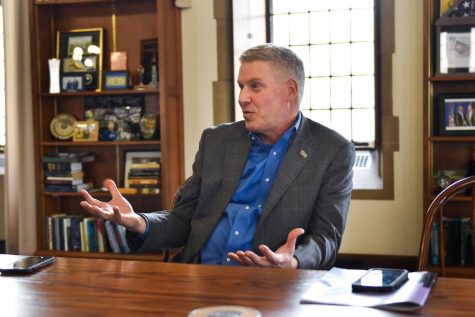
Chancellor Patrick Gallagher speaks during an interview in the Cathedral of Learning. (Pamela Smith | Visual Editor)
Changes that he’s seen aren’t coming from within Pitt, Gallagher said, and are instead coming from the national level. He finds it “interesting” that the role of universities in the post-World War II era is under debate, and said the country is “kind of waffling a little bit.”
“Now that countries around the world are spending a large part of their national treasure to copy and compete with us, we’re suddenly wavering about whether this was a good thing to do or an important thing to do,” Gallagher said. “We’re watching the number of men going into college declining relative to the number of women. We’re seeing state legislatures across the country, not just the Pennsylvania situation, trying to act like school boards for universities and tell them what they should teach and what they shouldn’t teach.”
Gallagher said it’s “really unfortunate” these conversations are occurring, with what he said was “no evidence” to truly question the role of higher education.
“In fact, the lifetime premium in terms of just economic wherewithal has never been higher between those with a college degree and those without,” Gallagher said. “I think for me that’s been the headwind that has gotten more significant during my time, and that’s hard. It’s not us — the good news is we’re going to face those headwinds from a position of relative strength. But they’re certainly frustrating and they’re certainly troubling.”
Gallagher said that, recently, the “little things” about serving as chancellor began to weigh more heavily on him, describing the role as one that “you have to pour yourself into.”
“It takes a commitment — you’re never off the clock. You’re very often in the public,” Gallagher said. “It takes an energy sort of at all times to do that. And I think there’s always a toll for that. And what you don’t want to do is realize that you’ve paid too big of a toll, right?”
Pitt isn’t the only major Pennsylvania university to face a transition at the top. Leaders at several other colleges and universities are also leaving their posts, includingat Penn State, which will have a new president beginning next month.
Gallagher said the average tenure for a university leader “isn’t that long anyway,” adding that “maybe that says something about the jobs nationally,” while also noting turnover can often be cyclical in nature.
“A lot of us started at about the same time,” Gallagher said. “I don’t think there’s any one thing driving this, I don’t think this is the ‘great resignation’ or COVID or anything like that.”
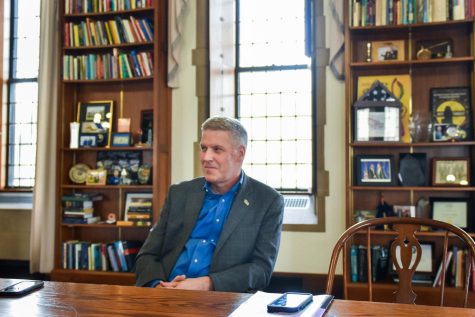
Chancellor Patrick Gallagher listens during an interview in the Cathedral of Learning. (Pamela Smith | Visual Editor)
Pitt, which has only hadmenserve as chancellor, said in a press release that the Board of Trustees will conduct a national search and expects to name Gallagher’s successor prior to his departure. Gallagher said he hopes the University will attract “diverse and vibrant and exciting and visionary” candidates.
“I mean, this is about your future,” Gallagher said. “It should not be a clone of me. We’re in a different place now than we were when I started, and you want somebody who’s perfectly suited, or best matched, to kind of take us that next [step].”
Among those surprised by the chancellor’s announcement, he said, was the chair of Pitt’s physics and astronomy department. Gallagher has said he would like to remain at Pitt as a full-time faculty member, and return to the classroom to teach physics.
“I used to be a high school science teacher, and so the idea of teaching introductory-level physics is really pretty appealing to me,” Gallagher said.
Asked whether he will seek ways to remain part of civic life, Gallagher said “I think there’ll be a lot — I think I will,” before adding that he is focusing his attention to “finish this job at full steam and then you’ll hear the gears grinding … as I sort of retool.”
As a professor, Gallagher would share in the collective bargaining agreementcurrently under negotiationbetween his administration and the nascent Union of Pitt Faculty, whichformedlast fall with overwhelming support. Asked whether he would pay dues and formally join the union, Gallagher said he would.
“I probably will, right?” Gallagher said. “That’s how you have a voice.”
Gallagher said Pitt has been known as a place that helped drive the region through the exodus of the steel industry to its current backbone of “eds and meds,” but added that Pittsburgh is a place that “not everybody in the community benefited from” — posing a challenge to create more opportunity.
“I think there’s now a more holistic, how do we create a Renaissance for everybody that lives here?” Gallagher said. “It’s really exciting, I think it’s right where a great university should be. It’s some of the most engaging and rewarding work I’ve done. And that would be a pretty cool thing to have at least started.”
Jon Moss has covered Pitt’s administration since spring 2019, and participated in more than a dozen interviews with the chancellor while writing award-winning coverage.
Roughly half of Pitt’smore than 7,000 employeesnow work remotely at least part of the week — a sea change in how the University does business, according to a top Pitt official.
“I’m really pleased that we’ve been able to advance this initiative as smoothly as we have, and to the extent that we have,” David DeJong, the senior vice chancellor for business and operations, said. “It’s a nice development, and we’ll see how it goes. I think we’re still in the early stages.”
The COVID-19 pandemic has accelerated efforts at Pitt to reimagine how physical space is used on campus, leading to increased remote work for staff with potentially more space for students and even cost savings for the University.
DeJong, who oversees everything from the police to dining and human resources, said the pandemic has taught Pitt that there are “a lot of arrangements that can work.”
“I think we’re all very sick of the 100% remote posture after a while,” DeJong said. “But man, when we’ve been able to come back — again, our goal wasn’t like a number [of people to work remotely], but it was what makes sense for our operations and then what makes sense for individuals.”
Pitt issuedan interim Flexible Work Arrangement policyin July 2021 for staff members, which allows for either Pitt to direct or an employee to request to work from a “designated work area,” such as an employee’s home. DeJong said the interim policy has roots from a listening tour he did while serving as the interim head of Pitt’s human resources department.
“We went out and we went on a listening tour, and were talking about things about working at Pitt that were great, things that could be better,” DeJong said. “We had a remote work posture at that time, but it was very rarely used and we just didn’t have the culture, and you know changing culture is tough. I thought that this would be something that we wouldn’t see immediate dividends for, but of course then the pandemic happened.”
Angie Coldren, the Staff Council president, remembered participating in the listening tour, which included many discussions on remote work, but also about other key topics.
“It was around things like child care, it was around things like parking, it was just a plethora of, ‘What is Pitt doing well? What can Pitt improve on? What changes can we make?’ Those types of things,” Coldren,the administrative support director in Pitt’s research protections office, said. “It was broad, but that was probably one of the biggest things.”
Coldren added that members of her organization have been working hand-in-hand with administrators to shape and implement the latest policies, and have been part of more planning efforts in the last year than likely ever before.
“I do think that we are pretty well-positioned there. I think that’s a positive thing because we give a different perspective than faculty and students. Not a better perspective, just a different perspective,” Coldren said. “I think it’s important to have someone on there from the staff side.”
DeJong pointed to one recent move as a potential model to replicate around campus. He said some employees from the chief financial officer’s office vacated space in the Cathedral of Learning, allowing for staff from the Office of Equity, Diversity and Inclusion to move from Webster Hall into the center of campus.
“An opportunity for them to be much more centrally located and accessible in advancing their mission,” DeJong said. “It’s a great outcome.”
He also noted that Pitt IT will have office space at 3512 Fifth Ave., located between McKee Place and Meyran Avenue,configuredspecifically for hybrid work arrangements. The building will include hoteling stations, offices and conference spaces.
David DeJong, the senior vice chancellor for business and operations, laughs in a Cathedral office last Tuesday. (Pamela Smith | Visual Editor)
DeJong said Pitt looks to “jump” at opportunities to repurpose and renovate spaces around campus.
“We’re always looking to make sure we’re making the best use of all of our resources,” DeJong said. “Space probably being the most — I don’t want to say the most precious one, but space is always a very important one.”
Coldren said her own office space — located in the Hieber Building, at the corner of Fifth Avenue and McKee Place — has been affected by the shift toward more remote work. Pitt used to occupy five floors, but she said it decided to combine four of the five floors.
“We all come in at different times because there isn’t enough space, so it’s true hoteling space,” Coldren said. “I have to reserve my office or I have to reserve my cubicle, so we basically need those laptops because we don’t have a permanent desk setup anywhere.”
DeJong didn’t have an estimate for potential cost savings in having so many employees work remotely — in particular whether some leases for off-campus space could be shrunk or not renewed.
He said a “really important consideration” that Pitt is working on right now is whether to compensate employees for work-related purchases to equip a home office, such as furniture or faster Internet.
“We’re updating the policy and we’re looking at questions like what sort of support — technical support, office furniture, office equipment — what sort of things will the individual be expected to cover, what sort of things will the University be expected to cover,” DeJong said.
Coldren said such expenses are something that Staff Council members “haven’t really discussed” with administrators, while noting employees are likely to save money on gas and car maintenance by not commuting everyday.
As staff members shuffle around campus, there are potential opportunities for Pitt to create more spaces dedicated to students. There has beenan ongoing campaignfor a LGBTQ+ student center, as well as Black studentsasking for a dedicated placeto congregate, outside of the Black Action Society’s current offices.
DeJong said he is “very aware” of student needs for space.
He noted that administrators are still assessing what specifically to do withthe former 20th Century Club building, located across from Chevron Science Center, saying it’s “one we’re looking at for a potential solution.”
“Outdoor recreational space, I would say, is top of the list. But I think that indoor gathering space, medium-sized spaces down to small rooms for, like, clubs and so on, is very much on our list,” DeJong said. “This could be an opportunity for that.”
Harshitha Ramanan, the Student Government Board president, did not reply to requests for comment.
More staff members working remotely can have a ripple effect that affects other parts of the University — including the Parking Services office, andits legendary waitlistfor the Soldiers and Sailors garage.
DeJong said Pitt is working to adjust its menu of parking options in order to “reflect the new reality that a lot of people have.” One example he pointed to is a system under development where multiple staff members could share a single parking pass, to avoid paying the full monthly rate.
“When all the dust settles, I think that we’ll have more parking capacity without adding more spaces,” DeJong said. “We’ll be able to accommodate a greater amount of the demand with the capacity we have, as we evaluate opportunities to address our capacity issues.”
DeJong said it will be crucial to see how things ultimately evolve on remote work.
“We’re experiencing this, we’re giving folks time to say, ‘Is this how we really want to stay? Is this the right balance?’” DeJong said. “Maybe some people are working 40%, they may end up going 60. We’ll have to see all of that. Right now, as I anecdotally talk to folks who are working in flex modes, they’re really happy.”
While Pitt students prepare for final exams next week, many will push spring sports to the back of their minds.
Pitt athletics, on the other hand, will continue competing as its spring teams wrap up their seasons.
Baseball, track and field and softball will all play over the course of the next week. If students need a change from the studying and exams, there are ample opportunities to watch the Panthers compete:
April 22-24: Baseball takes on the No. 5 Miami Hurricanes
The Panthers are rolling on the diamond, winningthreeconsecutive series against ranked ACC teams. Pitt is riding high aftertakingtwo of three from the No. 6 Virginia Cavaliers. While it has momentum on its side, Pitt has a few guys who are banged up at the moment. Star infielder senior Sky Duff injured himself on a slide last weekend and senior outfielders Kyle Hess, Ron Washington Jr. and Jordan Anderson did not finish the series against Virginia.
Despite injuries, head coach Mike Bell has still managed to produce a lineup that can battle with the conference’s best. On the backs of the consistent Panther pitching staff, Pitt has managed to remain in the middle of the pack of the Coastal Division. If Pitt wins the series against Miami, the Panthers will remain above .500in conference play. If not, Pitt will have an uphill battle to win the ACC.
April 22-24: Softball takes on the Virginia Cavaliers
Unlike the baseball team, Pitt softball has not fared as well in conference play this season. The Panthers have gone2-14in conference play and will likely miss the ACC Tournament, which Pitt is hosting.
Pitt did win an ACC game last weekend against the Boston College Eagles. But the series against Virginia is an unfavorable position for the Panthers to pick up another ACC win. Pitt will travel to Virginia for this series and take on a team who hasnineACC wins of its own.
April 22-23: Track and field goes to the Virginia Challenge
The track and field team will join the softball team and head down to Charlottesville, Virginia, for the Virginia Challenge. The Panthers had a couple of standout performances earlier this month at theDuke Invitationalin Durham, North Carolina, and will look to build off of that meet’s success.
While graduate student Felix Wolter picked up the only win of the weekend in the pole-vaulting competition, several Panthers posted career best times in their respective events. Head coach Alonzo Webb and his group will look to build on this success this weekend in Virginia.
Webb and the Panthers will also race the following weekend at the Penn Relays in Philadelphia.
April 29-May 1: Baseball welcomes North Carolina A&T to Pittsburgh
The Panthers will get a break from ACC play next weekend as North Carolina A&T comes to Pittsburgh. This series will give Bell the opportunity to rest his starting pitchers, who have pitched nearly every weekend since the season began, if he sees fit. Bell can use this weekend to give his players some time off before starting the final push for the ACC crown.
The most satisfying moments of Dr. Diego Chaves-Gnecco’s 20-year career as a Pittsburgh pediatrician come when his patients grow up and come back to visit him — sometimes, with kids of their own.
“When I see many of the kids that I first started taking care of 20 years ago, that now they are adults, that they have finished their high school, that they have finished college, that’s huge for me,” Chaves-Gnecco said. “When they tell me what they’re doing with their lives, that they’re giving back to the community, that’s huge. When they bring me their kids, and they say, ‘I want you to be my pediatrician for my child, because you were my pediatrician,’ that is also huge for me.”
After he became a pediatrician in his native Colombia, Chaves-Gnecco immigrated to the United States in 1998 at age 28 with the plan to train for a year in clinical pharmacology at Pitt. After his first year in Pittsburgh, he decided to stay for another year to pursue a master’s degree in public health — and then stayed for another two years because he was in the middle of conducting research.
Chaves-Gnecco said he eventually realized that he had more opportunities in Pittsburgh than in Colombia — from hospital technology to research journals available in libraries. He decided to continue practicing medicine in the U.S. — but first, he had to redo his residency in pediatrics.
As a resident at UPMC Children’s Hospital, he joined theCommunity Oriented Resident Educationprogram, where he created the first pediatric bilingual-bicultural clinic in southwestern Pennsylvania. Since its creation in 2002, the clinic has developed into the program known asSalud Para Niños, or “Health for the Children” in Spanish.
Salud Para Niños now holds three clinics each week in Oakland at the Primary Care Center of the Children’s Hospital. It also has one free clinic each week atCasa San Josein Pittsburgh’s Beechview neighborhood, using the Ronald McDonald Care Mobile, as well as another free clinic once a month at theBirmingham Free Clinicin the South Side.
Maya Ragavan, an assistant professor of pediatrics at Pitt’s medical school who does research on supporting immigrant and refugee communities, has collaborated on several research projects with Chaves-Gnecco in the past three years. She said this work is “a drop in the bucket” compared to all of the work Chaves-Gnecco has done for the Latino community of Pittsburgh.
“You talk to any family and they’re like, ‘Oh, Dr. Diego, Dr. Diego!’ which means that he really is just one of the most trusted voices in the Latino community here in Pittsburgh,” Ragavan said. “So many families see him, it’s really, really amazing.”
Romita Das | Senior Staff Photographer
To Chaves-Gnecco, an important part of Salud Para Niños is providing linguistically competent and culturally sensitive care. Besides having Spanish-speaking staff, and translation services for other languages, he emphasized the importance of having humility and curiosity about the cultures and perspectives that his patients come from. Even within the Latino community, he said there exists cultural differences between him and his patients.
“As a Colombian, for example, some of the things, some of the cultural practices that I have might be completely different than somebody from Mexico might have, or from Puerto Rico might have,” Chaves-Gnecco said. “So for us, it’s that sensitivity, that humility, to know that people come from different backgrounds, and that we need to meet them where they are coming from.”
Monica Ruiz, the executive director of Casa San Jose — an organization that aims to celebrate and advocate for Pittsburgh’s Latino community — said all five of her children see Chaves-Gnecco as their pediatrician. She said Chaves-Gnecco’s experience moving to the U.S. from Colombia gives him a stronger cultural connection to his patients.
“Many [other doctors] know the culture too, but he is an immigrant,” Ruiz, whose parents immigrated to the U.S., said. “He grew up in a different area, he knows what it’s like to be new in this country … it’s something that comes just so naturally from him. It comes from inside of him, it’s his passion, it’s his ethics, they’re his morals, and he just cares genuinely, like genuinely, about this population.”
Chaves-Gnecco said many of his patients at Salud Para Niños are either underinsured (for example, they have health insurance that doesn’t cover preventative care) or have no health insurance at all, and that number is only growing.
“Despite the pandemic, the last few years — 2020 and 2021 — have been the busiest years, the years that we are providing the most visits to uninsured patients,” Chaves-Gnecco said. “And in 2022, we’re on track already to surpass that number as well.”
Ragavan called it “unfair and unjust” that not every child in Pennsylvania has health insurance, and said Chaves-Gnecco goes above and beyond to serve children without it.
“He’s set up all these really cool collaborations with different specialists because, you know, it’s harder to get children who need specialist care if they don’t have insurance,” Ragavan said. “He spends hours trying to find the most — because, you know, if you don’t have insurance, then medication costs a lot of money — and so for five hours trying to find the cheapest version of a medication so families can use it.”
The work doesn’t stop when Chaves-Gnecco leaves the hospital, as he said he sees himself as a doctor outside of the exam room. He uses his platform as a doctor to share information with the Latino community about important health issues such as obesity, diabetes, physical activity, healthy habits and, more recently, COVID-19 and vaccines.
Romita Das | Senior Staff Photographer
This is sometimes through formal outlets, such as local Spanish news outletLa Mega Nota, but also through everyday interactions with other people. According to Ruiz, he makes announcements each week at the church they both attend.
“He’s up there every Sunday, ‘Wear your mask, get your vaccine,’ you know, he’ll say it to anybody that’ll listen to him,” Ruiz said.
Besides hosting clinics around the City, Salud Para Niños also hasHispanic/Latino Car Seat Checks, where families can have their car seats checked — and sometimes replaced — for free.
Chaves-Gnecco said over the last 20 years, Salud Para Niños has checked more than 650 car seats, and more than 250 have been replaced at no cost to families. The program also created a bilingual literacy project which provides bilingual books to children to get them reading at a younger age. The program has held several classes, including CPR training, in the community as well.
To Chaves-Gnecco, many of the services provided by Salud Para Niños are about tailoring existing services to the needs of the Latino population.
“We didn’t try to reinvent the wheel, we didn’t try to create anything new,” Chaves-Gnecco said. “The idea was, a lot of times, connecting services that were available.”
Chaves-Gnecco and Ragavan both said the myth of Latinos as an “invisible community” persists in western Pennsylvania — despite the fact that there are nearly35,000 Latinos living in Allegheny County alone. According to Ragavan, Chaves-Gnecco’s advocacy helps make the community more visible.
“I still hear people say to me, there are no immigrants in Pittsburgh, there are no Latino people in Pittsburgh, everyone in Pittsburgh speaks English,” Ragavan said. “That invalidates people. It makes them invisible, it makes their stories invisible and I think what Diego is doing is he makes people visible by what he does, he uplifts and amplifies people.”
One thing Chaves-Gnecco said he hopes people learn from the COVID-19 pandemic is that “we cannot leave any segment of the population behind” when it comes to health care.
“While there might be some cultural differences, like the language that we speak or the food that we eat, at the end, we’re all the same,” Chaves-Gnecco said. “We’re all human beings. And if you talk to a member of the Latino community — or any minority community, for that purpose — you probably are gonna learn that we’re much more alike than what we imagine. We all have the same dreams.”
When DongJo Kim came from South Korea to the United States in order to attend theUniversity of Utah, he couldn’t cook so much as a scrambled egg.
Within two years, Kim was drawing up plans to open up his own restaurant. Now, nearly four years later, he has more than7,000 Instagram followersjumping at the chance to eat his food.
Kim brought a bite of Korea to Allegheny County through his food in October 2020 with an unconventional take on an American classic — the corndog.
Although many who taste Kim’s food would tell you his food truck, named The BoonSeek, was destined to be a success, Kim thought otherwise when he first opened for business during the height of the COVID-19 pandemic.
After building his business for the past two years, loyal customers gather in huge lines in front of the Soldiers & Sailors Memorial Hall and Museum to eat his food. The menu features three variations of corn dogs, as well as traditional Korean street food.
Kim majored in chemistry in college, but instead of studying the periodic table, he was far more interested in honing his newfound passion for cooking. Kim said he was motivated to cook after longing for the food he grew up with.
“You know I first started cooking because it was cheaper, and then I started missing the food from back home,” Kim said. “I used to try to watch videos to learn Korean cooking and I began to like cooking more and more.”
Romita Das | Senior Staff Photographer
Kim met his wife, SuOk Lim, while in college and moved to Pittsburgh to support her while she studied at Pitt to obtain her master’s degree in social work. During this time, Kim said he continued creating his own recipes while working at a Korean restaurant, and began dreaming of opening up his own restaurant.
“I started working in a Korean restaurant in Pittsburgh, and I had been cooking for some time, so I wanted to open up my own restaurant so I could help introduce more people to Korean food,” Kim said.
Kim decided to take a leap of faith, and attempted to open up his own restaurant in December 2019. The pandemic hit soon after and Kim said it was “painful” when he had to scrap his plans.
“It was a little painful when the pandemic hit because it was obviously a block for my goals,” Kim said. “I was not very optimistic because the pandemic started, and I saw so many restaurants and businesses go out of business because all the people stopped eating outside and were so afraid, so I thought it was not a good time to open up a restaurant.”
For a couple of months, Kim said he felt completely “lost.” His well-laid plans and dreams seemed to be at risk as he watched other restaurants fail during the pandemic.
“When the pandemic started and I saw the lockdowns, I felt really lost and I didn’t know what to do anymore,” Kim said. “I knew I couldn’t open up a restaurant then but I didn’t want to give up on my dream.”
Lim said she saw her husband lose hope, and decided she would help him beat the odds, guiding him toward opening up a food truck. Lim said she thought a food truck would be a better start for him at that time since it seemed to be a smaller risk.
“I felt really bad for him because he had worked so hard to get his restaurant and the pandemic kind of ruined so much of that hope, but I didn’t want him to give up, and so I tried thinking of ways to help him,” Lim said. “I thought a food truck would be easier to start because people still need food, and it was kind of like curbside pickup so it would be good for the pandemic, so I told him to try to start a food truck.”
Lim said she saw a newly invigorated spirit in Kim as he began recipe testing and preparing for his food truck to open.
“He started getting excited about the food truck idea, and I saw a new change in him,” Lim said. “He began to have more hope and started creating new recipes and ideas that would be better for a food truck.”
Kim said he was grateful for his wife’s steadfast belief in his success. He fed off her strength to conquer his fears, and ultimately spent his savings on his food truck.
Romita Das | Senior Staff Photographer
“My wife helped me a lot, and because of the pandemic I couldn’t really afford to hire people, and so she offered to help me start it and it made me feel good to see how she believed in me,” Kim said.
Despite the pandemic forcing many restaurants to close, Kim opened up the window to his food truck in March 2020 during the height of lockdowns. He set up his truck in front of Lawrenceville’s11th Hour Brewing Company, where he awaited his first customers. Kim said the first few hours were agonizing as he waited for somebody to take a chance and try his food.
“I was really worried when I first opened because I was afraid no one would come, especially because there were no students, and while I waited I kept being afraid I had made a mistake,” Kim said.
Finally, he served his first customer, and then his second, and then a swarm of people during lunch hour. At that moment, Kim said he felt overjoyed and shared his happiness with his wife over text in the midst of filling orders.
“Then, after some time, a customer came, and then they just kept coming and there were lines because they liked my food,” Kim said. “I was so happy and I kept texting my wife while she was in class because I was just so happy they liked my food.”
Lim said she felt an enormous amount of pride when she heard that people lined up for her husband’s food.
“He kept texting me saying, ‘A customer came,’ and, ‘They liked the food,’ and I felt so proud of him because he was so happy and I just saw how his hard work paid off,” Lim said.
Kim said after that day, the lines just kept forming. His food became a new trendy spot, with customers posting his creations online.
“My customers, they really seem to like my food, and, you know, I have some very loyal customers that I see all the time, and they have really helped me on social media and on campus because they tell people about my food,” Kim said. “Every time I come back to campus I see even more people than before waiting to try my food and that is because of my customers’ support.”
Kim’s business boomed and he now employs twopeople, and is looking to hire another employee to help with the stream of orders.
Javes Ahn, one of his employees, said Kim’s work ethic is an inspiration and sees Kim as a food visionary.
“You know I started to work at the food truck because I thought it would be fun, and I am happy I did because DongJo works so hard, and it is super inspiring because you can see how happy he is to do his job,” Ahn said. “He clearly loves food, and a lot of times he is being creative with his menu and he clearly has a good vision for what type of food people will like.”
Kim said in light of his success, he is now looking to the future and hopes to open up another food truck. But he hasn’t given up his restaurant dream, either.
“I want to open up another food truck so I can do both lunch and dinner shifts at both the brewing company and at the University,” Kim said. “I also want to hire more employees so I can work more on the business itself and opening up more trucks or even maybe a restaurant hopefully in the future.”
Both Kim and Lim said they are grateful for their loyal customers, who call themselves “BoonSeekers.” They said they couldn’t have done it without their support.
“We owe so much to our customers and our followers on Instagram, who we call BoonSeekers,” Kim said. “Because of their encouragement and advice for our business we were able to survive the pandemic.”